



On May 26, 2026, Argo signed an exclusive worldwide license agreement with Grapherry, Inc. for STREAM, Grapherry’s proprietary graphene production platform, with a contractual path to full ownership.
That single decision reshaped Argo’s construction materials strategy, brought STREAM’s inventor onto the company as CEO, and set up the results Argo has published since.
Here’s what the agreement actually secured, what changed once Dr. Vikas Berry took over, and what it means for Argo’s construction work going forward.
Key Findings
- Argo signed its exclusive license and technology transfer agreement with Grapherry on May 26, 2026.
- The agreement includes a staged path to full ownership, tied to financing and production milestones.
- Dr. Vikas Berry joined Argo’s Board of Directors on June 29, 2026, and became CEO on July 17, 2026.
- Argo’s cement additive test, the first published result using STREAM-produced material, was announced on July 13, 2026.
- The test reported a 60% increase in ultimate compressive strength at a graphene oxide dosage of 0.05% of cement weight.
- Argo’s earlier concrete and asphalt programs used a different graphene supply, before the Grapherry agreement existed.
The Short Answer
Argo licensed STREAM from Grapherry in May 2026, gaining exclusive rights to a graphene production platform capable of making both STREAM-G graphene and STREAM-O graphene oxide, with a defined path to owning the technology outright.
Two months later, Dr. Vikas Berry, the scientist who invented STREAM and founded Grapherry, became Argo’s CEO.
Since then, Argo has published its first result explicitly tied to STREAM-produced material: a cement additive test showing a 60% increase in ultimate compressive strength at a dosage of just 0.05% graphene oxide by cement weight.
Importantly, Argo’s earlier concrete and asphalt testing used a different graphene source, before STREAM became part of the company.

What the Grapherry Agreement Actually Secured
The license gives Argo exclusive worldwide rights to develop, manufacture, and commercialize STREAM for an initial ten-year term.
More importantly, the agreement is structured to convert into outright ownership. As Argo completes a series of milestones, including a financing round, commissioning a production facility that meets independently verified capacity standards, and reaching a revenue target, full ownership of the platform and its intellectual property transfers automatically.
That’s a materially different arrangement from a standard supply contract.
A supplier relationship gives a company access to material. This agreement gives Argo a claim on the production process itself, along with a route to scaling production on its own terms rather than depending on someone else’s factory.
Why Dr. Vikas Berry Becoming CEO Matters

The person who invented STREAM didn’t just license it to Argo. He joined the company to run it.
Dr. Berry, founder of Grapherry and inventor of the STREAM platform, joined Argo’s Board of Directors on June 29, 2026, and was named Chief Executive Officer on July 17, 2026, succeeding interim CEO Sean McAlpine.
That is a significant development in how Argo is approaching the platform. Rather than relying on a licensing relationship at arm’s length, the company now has STREAM’s inventor leading its direction and commercialization.
The scientist who understands the platform’s capabilities and limitations is now directly involved in deciding how Argo develops and applies the technology.
The First Result Under the New Structure
Argo’s cement additive test, announced on July 13, 2026, is the clearest proof point so far.
Using graphene oxide produced through STREAM, at a dosage of just 0.05% of the cement weight, Argo reported a 60% increase in ultimate compressive strength.
The company stated that the result was reproduced consistently across multiple independent test batches.
The same announcement confirmed Argo’s membership in the Advanced Carbons Council, another step toward positioning STREAM within the broader advanced materials industry rather than as a single-application additive.

A Quick Note on Earlier Testing
Argo’s Bristol, Tennessee concrete pour and its Saskatchewan asphalt testing program both began before the Grapherry agreement existed.
Those programs used a different graphene supply that Argo had secured earlier. Their results are part of the company’s broader materials testing history, but they should not be confused with results from the STREAM platform.
This distinction matters when evaluating the company’s progress. The earlier testing established a foundation in construction materials, while the July 2026 cement additive announcement provided a result specifically tied to STREAM-produced graphene oxide.

What This Means Going Forward
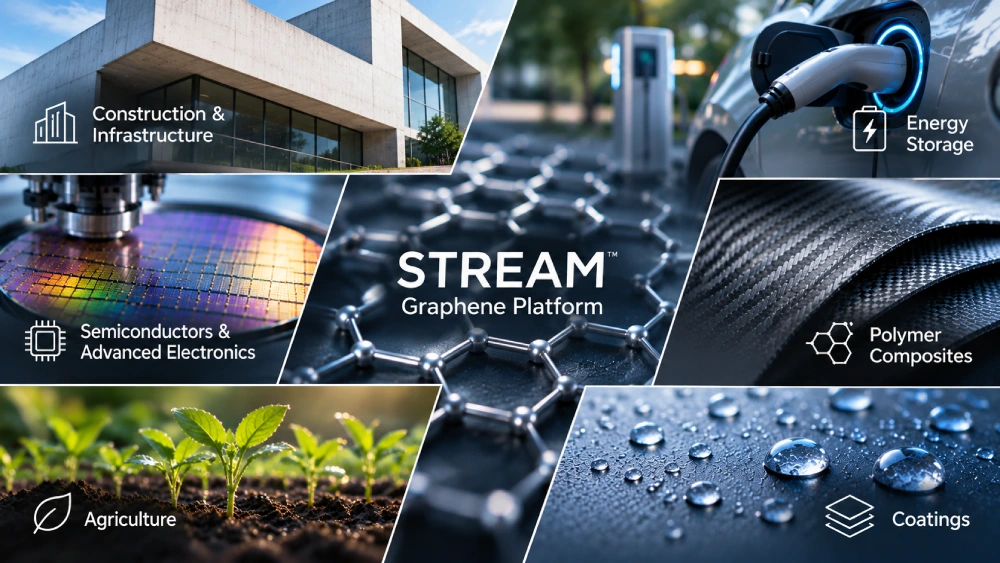
Owning the production process, rather than simply buying the material, gives Argo a potential foundation for pursuing multiple markets from one technology base.
These include:
- Construction and infrastructure
- Energy storage
- Semiconductors and advanced electronics
- Polymer composites
- Other industrial applications
- Agriculture
- Coatings
Instead of building a separate supply chain for every market, Argo is positioning STREAM as a shared production platform that can support different graphene materials and application requirements.
With Dr. Berry now leading the company and one confirmed result tied directly to STREAM already published, the platform has moved beyond the initial licensing announcement. The next stage will depend on production development, further application testing, and commercial execution.
Questions About the Grapherry Agreement, Answered
Not yet. Argo holds an exclusive worldwide license with a defined path to full ownership. The transfer is tied to financing, production, and revenue milestones outlined in the agreement.
Dr. Berry invented STREAM and founded Grapherry. Having him lead Argo means the platform’s inventor is directly involved in guiding its development and commercialization.
Argo’s cement additive test, announced on July 13, 2026, reported a 60% increase in ultimate compressive strength at a graphene oxide dosage of 0.05% of cement weight.
No. The Bristol concrete program and Saskatchewan asphalt testing began before the Grapherry agreement and used a different graphene supply. The July 2026 cement additive result was the first published result specifically tied to STREAM-produced material.
The Bottom Line
Argo didn’t just buy graphene. It licensed the platform that makes it, brought on the person who built that platform to run the company, and has already published results tied directly to it.
That’s a meaningfully stronger position than a standard supply arrangement, and it’s still early going.
Conclusion
Licensing STREAM gave Argo more than access to graphene material. It gave the company a route toward owning the production platform itself, brought the platform’s inventor into the CEO role, and established a foundation for further application development.
The first published cement additive result tied to STREAM provides an early performance milestone. The next challenge is turning that technology platform into scalable production and broader commercial applications.
For the technical details behind the production process, read What Is STREAM, and Why Is Argo Building Its Strategy Around It?. For a closer look at its construction applications, explore our article on graphene cement for stucco and 3D-printed construction.
Explore Argo’s Graphene Technology
Discover how Argo is developing its STREAM platform and exploring graphene applications across construction, energy, and advanced materials.
Explore Applications